A Hybrid Model for Hydrophobic Interaction Chromatography Characterization for the Pharma Industry
Project collaborators
Boehringer Ingelheim
Maria Oros and Lisa Je, DSI
Project start and end dates
April 2025-March 2026
Project summary
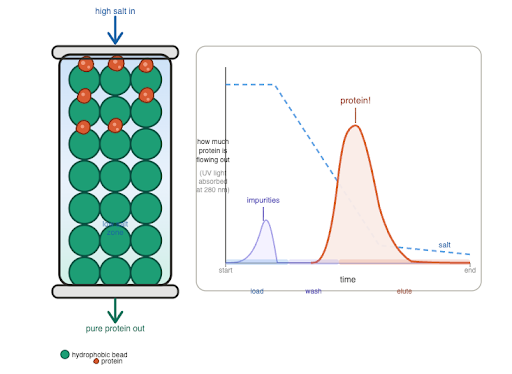
DSI partnered with a biopharmaceutical client to tackle protein purification, which is one of the most critical and costly steps in drug manufacturing. To do this, wet lab scientists use a technique called hydrophobic interaction chromatography (HIC) to separate the target protein from impurities by passing a solution through a specially designed column. Getting this process right typically requires many time-consuming and expensive lab experiments.
DSI developed a complimentary approach to experiments by combining two types of computational models into what is known as a grey box model to identify ideal parameters for the HIC solution for protein purification. Traditionally, models fall into two camps: “white box” models, which are mechanistic models based on physical laws, and “black box” models, which are powered by machine learning and learn purely from data. In this case, the white box component captures the fundamental chemistry of how proteins adsorb (bind) and elute (release) inside the chromatography column, while the machine learning component learns patterns from experimental data that humans may miss. The result is a computational framework that is both interpretable in the chemical purification process and powerful in identifying high-impact parameters based on the experimental dataset provided by the client.
The computational framework can predict how much purified protein a given process will yield. The result is a user-friendly, reusable simulation platform built in CADET-Python (a scientific software framework for chromatography modeling) that can reliably reproduce past experiments and generate predictions for new ones under a wide range of parameters, such as changes in salt concentration, pH, or sample volume. This gives process development teams a way to explore and optimize their purification process digitally and better understand adsorption dynamics and elution profiles to support downstream process development.
Project deliverables
- Mechanistic modeling and data-driven modeling frameworks, compiled into a reproducible private repository